In industrial tissue converting, cutting is one of the most critical stages of the entire production process. In the AfH segment, handling rolls with higher density, larger diameters and stronger cores requires extremely precise process control. Industrial log saws are subject to significantly greater stresses than those used in consumer applications, and their performance depends on the balance of multiple design factors that directly affect finished product quality, production continuity and overall line reliability.
One of the key factors influencing these parameters is cutting dynamics: the way the blade and log interact during the cutting process. Blade trajectory, contact time with the material and force distribution directly affect cutting quality, machine dynamics and the stresses generated throughout the operating cycle.
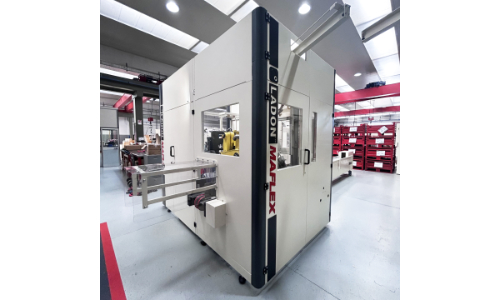
This was the starting point for the development of the new LADON Evo, which builds on the previous generation, LADON Plus — a log saw already capable of reaching speeds of up to 120 cuts per minute and featuring a distinctive “bean-shaped” blade orbit that offers significant advantages in cutting dynamics compared with traditional circular or elliptical movements.
“When an engineering solution delivers tangible advantages, the real opportunity is to develop and optimize it further, rather than replace it. With LADON Evo, we did not ask ourselves how to simplify an already effective kinematic system. We asked how we could control it more effectively in order to maximize its advantages. At the same time, we introduced important design improvements to simplify operations and make the operator’s work easier,” explains Jonathan Ciomei, R&D Manager at Maflex.
Maflex’s experience in developing this kinematic system has played a key role in the evolution of the new LADON Evo. The refinement of motion control, based on the principle of balancing kinetic energy, has improved process precision, stability and repeatability, contributing to a 15% increase in maximum cutting speed compared with the previous generation, without changing the underlying design principle.
From Design Philosophy to Engineering Solutions
Over the years, many converters have encountered recurring challenges during the cutting process, including process instability, accelerated component wear, variations in product quality and the need for frequent operator adjustments.
“When we observe a machine in operation, we do not simply look at what can be improved. We try to understand why a specific event occurs. Every engineering evolution is a response to a real need identified in the field,” Ciomei continues.
Engineering Details That Make the Difference
The universal clamp system has long been a distinctive feature of Maflex industrial log saws. With LADON Evo, the objective was to reduce mechanical complexity and the number of moving components subject to wear, while maintaining the same performance and the ability to automatically handle a wide range of diameters. The redesign has resulted in a 27% reduction in the total number of components, simplifying the system’s kinematics. Increasing the number of contact points from three to six also provides more effective log containment during cutting, contributing to greater process stability and more consistent finished product quality.
Accessibility to the main machine units is becoming increasingly important in industrial equipment design, as it directly affects both intervention times and operator safety. In keeping with Maflex’s modular philosophy, LADON Evo is a compact machine with a limited footprint and a redesigned structure that facilitates access to the sharpening and grinding dust extraction units while simplifying operator tasks. Both routine and extraordinary maintenance activities can now be carried out more quickly and safely, improving day-to-day machine management.
Cutting precision also depends on the system’s ability to maintain mechanical stability over time. For this reason, a new engineering solution has been introduced on the LADON Evo blade shaft, achieving a 32% reduction in mechanical play while increasing system rigidity and helping to ensure consistent cutting precision. The new configuration also facilitates blade replacement, making the operation faster and safer for the operator.
Designing an industrial machine also means making it easier to manage throughout its different operating stages and across its entire life cycle. The blade positioning and dimensional measurement system used on Maflex log saws supports the operator during a particularly delicate stage: commissioning a new blade.
“Controlling this operation is essential to safeguarding both the process and the machine. Likewise, wherever possible, we favor the use of commercially available components, improving spare parts availability and simplifying replacement operations,” comments Ciomei.
Designing machine reliability also means considering how unexpected events are managed. For this reason, LADON Evo incorporates components specifically designed to provide protection within critical systems such as the arm and blade transmissions.
“These components, known as ‘sacrificial’ elements, are designed to intervene in the event of overloads, protecting the main transmission components and preventing damage to more complex and costly elements such as motors and gearboxes,” Ciomei explains. This engineering choice is aimed at reducing the impact of unexpected events, simplifying recovery operations and enabling the machine to return to production more quickly.
Conclusions
The new LADON Evo represents the evolution of a proven design that continues to develop through experience gained in the field, observation of real production conditions and constant dialogue with converters.
“A machine truly evolves when every engineering decision starts from a real production need. With LADON Evo, we focused our work on the details that affect machine behavior, performance and the routine operations carried out by operators every day,” concludes Jonathan Ciomei, Mechanical Engineering Supervisor – R&D Manager at Maflex.
Photo/Maflex
RELATED NEWS