As a long standing tradition world’s pulp producers and users gathered to London in November around several industry events and one-on-one meetings. The discussions were dominated by China’s expanding industrial capabilities, persistent pulp overcapacity, pressure on wood supply and the growing role of artificial intelligence. Although the market outlook remains challenging, the week also highlighted clear opportunities to create value through specialization, efficiency and industrial autonomy.
Valmet had a strong presence at various events throughout the week. Pulp, Paper and Forestry Women Association kicked off London Pulp Week at a cross-industry gathering already on Sunday. The theme of the event “The Future is Flexible” and Ellen Saman’s presentation sparked interesting discussions on how hybrid work, AI and new social contracts are impacting work for women leaders in the Pulp and Paper industry. Meaningful dialogue was a great facilitator for building networks with customers and collaboration partners.
Putting the focus on growing dissolving and fluff pulp
On Tuesday, Hawkins Wright and AFRY hosted a new seminar focusing on dissolving and fluff pulp. 150 industry executives and market specialists came together to examine the changing competitive landscape under the theme “From customer to competitor: China’s changing role in global cellulose markets”. The seminar explored how China’s expanding domestic capacity and growing exports are reshaping global markets. The event also covered developments in cost competitiveness, trade policy, fibre substitution and innovation.
How Valmet can support in the era of China’s transformation and the rise of industrial AI
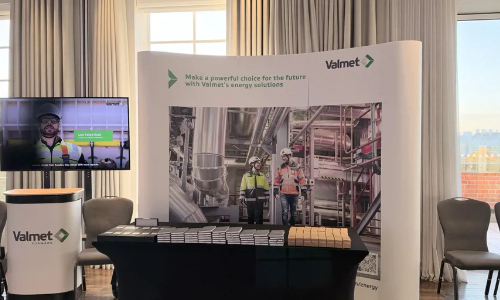
Valmet’s own breakfast seminar was arranged on Wednesday morning. Almost fifty people gather together around the key topics. Max Luedtke, who recently took over the role of Executive Vice President for Valmet’s Pulp, Energy and Circularity business area, opened the event and asked the audience to think “What is the most important improvement they would like Valmet to help you achieve over the next 2-3 year”.
At the event Jinping He and Paulo Aguiar examined how China’s accelerating pulp integration, domestic fibre investments and expanding production capacity are reshaping global pulp markets. Major companies in China are responding to competitiveness challenges by integrating pulp and paper production, increasing mill scale, improving energy and operational efficiency, and investing in advanced technology. Despite the expansion of domestic production, China’s competitiveness continues to depend heavily on imported hardwood chips, forest productivity and raw-material costs.
In his presentation Samuli Lehtonen discussed how industrial AI can help pulp and paper mills progress from automated individual processes towards coordinated, mill-wide autonomous operations. The presentation emphasized that labour represents only around 5% of mill cash costs but human-related factors, including limited situational awareness, manual operation and over-adjustment, are associated with approximately 65% of process instability. Progress towards autonomous mill’s that utilize industrial AI will require reliable automation, high-quality data, robust governance and secure, future-proof platforms. He concluded that industrial autonomy should be managed as a business transformation programme, with leadership setting clear targets, establishing ownership and measuring outcomes in euros per tonne rather than pursuing isolated AI pilots.
Finding value in a market under pressure
The week culminated in Hawkings Wright Symposium on Thursday followed by a dinner organized by British & World Pulp Association (BWPA). At the symposium speakers represented a broad range of perspectives across the pulp and paper value chain. Tom Wright of Hawkins Wright opened with an overview of the global market environment and geopolitical risks, while James Kynge of the Financial Times explored China’s rapid technological rise, manufacturing strength and AI ambitions. Marcio Farid of Goldman Sachs examined the financial performance and competitiveness of the pulp industry, including the growing importance of Latin American assets and consolidation. Robert Taylor from UPM addressed forestry, fibre availability, climate resilience and the increasing competition for wood, while Tomas Höglund from Valmet continued how the different fibers are utilized efficiently into end products. The programme also included a McKinsey perspective on AI-enabled operating models and competitiveness. As a tradition the last presentation was given by Oliver Lansdell from Hawkins Wright, giving an extensive market outlook covering global pulp demand, capacity developments, pricing and the growing influence of China and Indonesia on global supply.
The last time Valmet presented at the Symposium was 15 years ago. In his presentation “What if pulp was not only a commodity?” Tomas Höglund reflected back to the presentation from 2011 by Gunnar Carré and actually reversed then given statements of pulp not being tailored to specific paper qualities. He discussed the changing global pulp landscape and the potential to move from commodity pulp toward more fit-for-purpose fibres tailored to end-product needs. He colucded his presentation with four key points:
- Global market for fiber-based products will grow
- Each fiber has its use
- Tailoring pulp for end use is the key
- Pulp doesn’t need to be just a commodity
Photo/Valmet
RELATED NEWS